Need it handled? Call (619) 333-9400
Car Detailing: Ride N' Shine can help. Call (619) 333-9400 for a free estimate.
TL;DR: El Cajon's hard water (averaging 270–300 mg/L total dissolved solids) creates mineral deposits on car paint faster than most of the country. A three-level severity system helps you pick the right removal method - from a $3 vinegar solution for fresh spots to professional paint correction ($150–$600) for etched damage. Most Level 1 and 2 spots can be handled at home in 15–90 minutes.
In This Article
- Why El Cajon Has a Serious Water Spot Problem
- How Bad Are Your Water Spots? (3-Level Severity Check)
- Step-by-Step: Remove Water Spots at Home (All 3 Levels)
- Which Products Work Best for El Cajon Hard Water?
- How Do You Prevent Water Spots From Coming Back?
- When Should You Take Your Car to a Detailer in El Cajon?
- Professional Water Spot Removal in El Cajon
- Recommended Car Detailing in El Cajon: Ride N' Shine
- Frequently Asked Questions
- Next Steps: Protect Your Paint Today
Why El Cajon Has a Serious Water Spot Problem
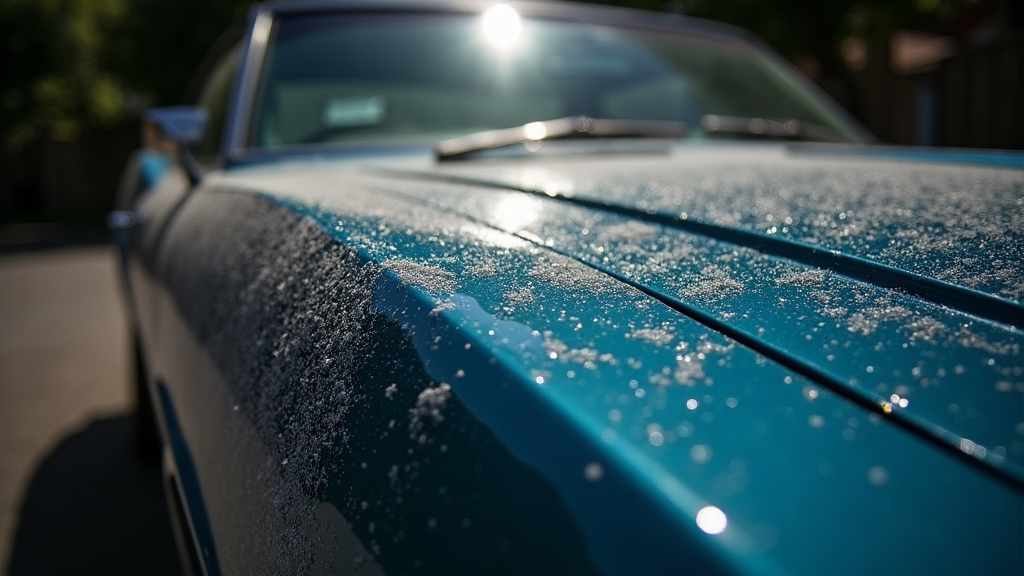
If you've parked your car in El Cajon and noticed stubborn white or cloudy spots on the paint within hours of rain or sprinkler overspray, you're dealing with a problem that's worse here than in most of the country. (Usbr.gov) (Usgs.gov) Our local water supply - delivered through the San Diego County Water Authority from the Colorado River and State Water Project - carries significantly higher mineral content than "soft" water regions.
San Diego County's municipal water averages 270–300 mg/L in total dissolved solids, roughly 16–18 grains per gallon of hardness. That's well above the 60–120 mg/L threshold that water quality guidelines consider soft. The culprits are calcium and magnesium carbonates from the Colorado River, minerals that precipitate instantly when water evaporates on your vehicle's warm paint surface.
Here in El Cajon, the problem accelerates because of our inland valley climate. Summer highs regularly exceed 95°F, sometimes climbing past 110°F. That heat means water doesn't just evaporate - it flash-evaporates, concentrating minerals before you can rinse them away. Add Santa Ana wind events (which drop humidity below 15% while raising temperatures), and you've got a 24–48 hour window before mineral crystals bond chemically to your clear coat.
Key Takeaway: El Cajon's hard water and heat create water spots 2–3 times faster than cooler, softer-water regions. Generic removal guides don't account for this local intensity.
How Bad Are Your Water Spots? (3-Level Severity Check)
Before you grab a product or tool, diagnose what you're actually dealing with. Water spot damage falls into three distinct levels, and using the wrong method on the wrong level wastes money and risks your paint. You can also explore Car Detailing services.
Level 1: Fresh Surface Deposits (Less Than 48 Hours Old)
These are mineral particles sitting on top of your clear coat - not yet bonded chemically. They look like white or cloudy spots, and they wipe off easily with a damp microfiber cloth if you catch them immediately. Use the fingernail test: gently run your fingernail across the spot. If it catches or feels rough, you're past Level 1. If it's smooth, you're still in the safe zone.
Level 2: Etched Mineral Bonds (Days to Weeks Old)
At this stage, minerals have begun bonding to the clear coat surface. The spots don't wipe away with water alone. Under direct sunlight or cross-lighting (shine a flashlight at a low angle), you'll see faint hazing or a dull ring around the spot. The credit card edge test works here: run the edge of a credit card gently across the spot. If you feel resistance or slight texture, the minerals have etched in.
Level 3: Paint Etching With Clear Coat Damage (Weeks to Months)
This is where DIY stops and professional correction begins. The mineral deposits have actually eaten into the clear coat, creating permanent micro-pits. You'll see a visible depression under direct light, sometimes with a rainbow or iridescent effect. The spot may feel slightly sunken compared to surrounding paint. At this level, topical treatments won't work - you need abrasive correction or professional paint restoration.
Step-by-Step: Remove Water Spots at Home (All 3 Levels)
Level 1: Fresh Spots (Vinegar or Quick Detailer Method)
What you'll need:
- White vinegar (5% acetic acid) - about $3
- Distilled water
- Microfiber towels (2–3)
- Spray bottle
- pH-neutral car wash soap (~$12)
The process (15–20 minutes):
- Park in shade. Work when the paint surface is below 85°F. El Cajon's heat means early morning or late evening is essential - direct sun will cause the solution to evaporate before it works.
- Dilute the vinegar. Mix one part white vinegar with three parts distilled water in a spray bottle. This 1.25% acetic acid solution is strong enough to dissolve fresh calcium carbonate without stripping wax.
- Spray the spotted area. Apply the diluted vinegar generously to the water spots. Let it sit for 2–3 minutes - no longer, especially on waxed or ceramic-coated paint.
- Wipe with a microfiber towel. Use gentle circular motions. The spots should dissolve and lift away. If they don't budge after 3 minutes, you've likely moved to Level 2.
- Rinse thoroughly. Spray the area with distilled water to remove all vinegar residue. Vinegar left on paint can etch if it dries.
- Dry immediately. Use a clean, dry microfiber towel. This prevents new water spots from forming during the drying process.
Safety note: Never use undiluted vinegar on ceramic-coated paint - the acidity can degrade the coating over time.
Level 2: Set Minerals (Clay Bar + Water Spot Remover)
What you'll need:
- Detailing clay bar kit (~$20–$30, includes lubricant)
- Water spot remover (Chemical Guys Heavy Duty or Meguiar's, ~$14–$17)
- Microfiber towels (4–5)
- pH-neutral car wash soap
- Spray bottle with distilled water
- Bucket of water
For more details, see Car Detailing or How Much Does Mobile Car Detailing Cost in San Diego.
The process (45–90 minutes for a mid-size sedan):
- Wash the area first. Use pH-neutral car wash soap and water to remove dust and loose contaminants. Dry completely with a microfiber towel.
- Knead the clay bar. Work it in your hands until it's soft and pliable. Fold it in half a few times to expose a fresh surface.
- Apply lubricant. Spray the clay bar lubricant (included in the kit) generously onto a 2×2 foot section of paint. This prevents the clay from scratching.
- Work the clay bar. Using light to medium pressure, glide the clay bar across the spotted area in straight lines, not circles. You'll feel the clay grab and release as it pulls contaminants away. Re-spray lubricant every few passes.
- Inspect and repeat. Wipe the area with a microfiber towel. If spots remain, apply the dedicated water spot remover according to the product instructions (typically 2–5 minute dwell time).
- Final rinse and dry. Rinse thoroughly with distilled water and dry with a clean microfiber towel.
Why this works: Clay bars physically decontaminate bonded minerals that chemical treatment alone can't dissolve. The combination of mechanical and chemical action removes Level 2 spots without abrasive polishing.
Level 3: Etched Paint (Light Polish Approach)
Level 3 spots require machine polishing, which carries real risk of burning through clear coat if you're inexperienced. Here's when to stop and call a professional:
- Visual signs: You see a permanent depression or pit under direct light, not just hazing.
- Tactile signs: Your fingernail catches in the spot, or the credit card edge reveals a sunken area.
- Multiple spots: If more than 10–15% of the paint shows Level 3 damage, professional correction is the safer choice.
If you have a DA (dual-action) polisher and experience, use a light cutting pad at speed setting 3–4 with a fine-cut compound. Work in 60-second passes, checking frequently with a paint depth gauge to avoid removing more than 20% of the clear coat thickness. This is where mistakes become permanent. Professional detailers use paint depth gauges before and after correction to ensure safety - a tool most DIYers don't own.
Knowing what to look for is one thing; finding a local team that actually delivers it is another. Ride N' Shine is one serving El Cajon — clear about what they do, upfront on pricing, and easy to reach before you commit to anything.
✓ Recommended locally: Ride N' Shine
Serving El Cajon. Call (619) 333-9400 or get in touch »
Which Products Work Best for El Cajon Hard Water?
Not all water spot removers are created equal, especially when dealing with El Cajon's calcium-carbonate-heavy deposits. Here's a comparison of the most effective options:
| Product | Best For | pH / Chemistry | Cost | Notes |
|---|---|---|---|---|
| Diluted White Vinegar (DIY) | Level 1 fresh spots | Acidic (pH 3–4) | ~$0.50 per use | Cheapest option; works fast on new deposits; avoid on ceramic coatings |
| Chemical Guys Heavy Duty Water Spot Remover | Level 2 etched minerals | Acidic (pH 4–5) | ~$16 | Formulated for heavy calcium deposits; safe on wax and sealants; requires 2–5 min dwell |
| Meguiar's Water Spot Remover | Level 1–2 light to moderate spots | Acidic (pH 4–5) | ~$14 | Gentler formula; good for regular maintenance; works on glass and chrome too |
| Griot's Garage Brilliant Finish | Level 1 prevention / light spots | Neutral pH | ~$18 | Doubles as a sealant; prevents future spots; slower on heavy deposits |
Why acidic removers win on El Cajon water: The chemistry is straightforward. Calcium carbonate (the dominant mineral in our hard water) dissolves readily in acidic solutions through the reaction CaCO₃ + 2HC₂H₃O₂ → Ca(C₂H₃O₂)₂ + H₂O + CO₂. The calcium acetate product is water-soluble and rinses away. Neutral or alkaline products simply don't break that chemical bond as effectively.
One critical warning: Never use undiluted vinegar or leave acidic removers on ceramic-coated paint for more than 5 minutes. Ceramic coatings sit atop the clear coat, and prolonged acid exposure can degrade the SiO₂ layer, defeating the coating's purpose.
How Do You Prevent Water Spots From Coming Back?
Removing water spots is one battle; preventing them is the war. Here in El Cajon, prevention is worth the effort because our hard water makes spots inevitable without intervention.
Immediate response (the most effective strategy):
Rinse and dry your car within 1–2 hours of sprinkler contact or rain. In El Cajon's heat, this window shrinks fast - mineral concentration accelerates in direct sun. If you park under a sprinkler zone, adjust the sprinkler heads to avoid your vehicle, or relocate your parking spot if possible.
Filtered water for final rinse:
An inline deionizing or carbon filter attachment for your garden hose (~$25–$40) reduces total dissolved solids to near-zero. Use filtered water for your final rinse after every wash. This single step eliminates the mineral source entirely and is especially valuable here in El Cajon where tap water TDS is so high.
Long-term protection (coating options):
- Carnauba wax (~$15–$30, lasts 3–6 months): Hydrophobic layer that causes water to bead and roll off, reducing evaporation time. Affordable but requires frequent reapplication.
- Paint sealant (~$30–$80, lasts 6–12 months): Synthetic polymer that bonds to clear coat, offering stronger water beading and longer durability than wax.
- Ceramic coating (~$500–$1,500 professionally applied): Multi-year hydrophobic protection (2–7 years depending on product and maintenance). Water beads aggressively, and mineral deposits sit on top of the coating rather than etching into clear coat. Highest upfront cost but lowest long-term maintenance.
On ceramic-coated paint, water spots are easier to remove because minerals don't bond to the SiO₂ layer the way they do to polyurethane clear coat. If you're dealing with recurring water spot problems in El Cajon, ceramic coating is a legitimate long-term solution - though it requires professional application and ongoing care.
Parking strategy:
Shade structures and covered parking dramatically reduce evaporation rate. If you have access to a garage or carport, use it. Even a car cover (when parked, not while driving) reduces sun exposure and slows mineral crystallization.
When Should You Take Your Car to a Detailer in El Cajon?
DIY water spot removal works well for Levels 1 and 2, but there's a hard line where professional correction becomes necessary - and crossing it without proper equipment risks permanent paint damage.
Clear signals that DIY has reached its limit:
- Hazing or swirl marks appear after your polishing attempt
- Rainbow or iridescent effect visible under sunlight (sign of clear coat thinning)
- Sunken pits that your fingernail catches in
- Spots covering more than 15–20% of the paint
- Uncertainty about paint type (single-stage vs. clear coat) - older vehicles may have single-stage paint where modern polishing compounds cause permanent color loss
Professional paint correction costs in El Cajon / San Diego:
- Single-stage correction (one pass, light defects): $150–$300
- Two-stage correction (cut and polish, moderate damage): $300–$600
- Multi-stage with ceramic coating (full restoration + protection): $600–$1,500+
Before booking, ask the detailer three questions:
- "Do you use a paint depth gauge?" This is non-negotiable. A professional should measure clear coat thickness before and after correction to ensure they're not removing too much.
- "What's your process for water spot removal specifically?" They should describe clay bar treatment, chemical removal, and polishing as separate steps - not a one-size-fits-all approach.
- "Will you apply a sealant or ceramic coating after correction?" Post-correction protection is essential to prevent new spots from etching in immediately.
Here in El Cajon, where hard water makes spots a recurring issue, professional correction paired with ceramic coating is often the most cost-effective long-term solution. You pay once for correction and coating, then enjoy 2–7 years of hydrophobic protection that makes future spot removal trivial.
Professional Water Spot Removal in El Cajon
If you've diagnosed Level 3 damage or prefer to skip the DIY process entirely, professional detailing is the safest route. Local providers like Ride N' Shine Mobile Auto Detailing bring the expertise and equipment directly to your driveway, eliminating the need to drive to a shop.
With over 29 years of hands-on experience, Ride N' Shine specializes in water spot removal, paint correction, and ceramic coating application - exactly the services El Cajon car owners need given our hard water conditions. Their team uses paint depth gauges to ensure safe correction and can apply protective coatings to prevent future spots. They serve El Cajon, San Diego, La Mesa, Santee, Lakeside, and surrounding areas, offering mobile service that fits your schedule.
Whether you're dealing with fresh spots that need quick removal or etched damage requiring professional correction, having a trusted local detailer on speed dial saves time and protects your investment. You can learn more about their services at https://detailmyrides.com.
Recommended Car Detailing in El Cajon: Ride N' Shine
If you'd rather skip the search, Ride N' Shine serves El Cajon and handles this end to end — with clear pricing and a straight answer on timing before you commit.
Frequently Asked Questions
Does white vinegar damage car paint when removing water spots?
Direct Answer: Diluted white vinegar (1 part vinegar to 3 parts water, roughly 1.25% acetic acid) is safe on clear coat and waxed paint when used for 2–5 minutes. Undiluted vinegar or extended dwell times can strip wax and soften some sealants.
Acetic acid dissolves calcium carbonate through a straightforward chemical reaction, but the key is dilution and timing. Rinse thoroughly after treatment to remove all vinegar residue. Never use undiluted vinegar on ceramic-coated paint - the acidity can degrade the SiO₂ coating over time.
Is WD-40 safe to use on water spots on car paint?
Direct Answer: WD-40 is not recommended for water spot removal. It's a penetrating oil, not a mineral dissolvent, and it can leave a slick residue that attracts dust and creates new problems.
Stick to acidic water spot removers (vinegar, Chemical Guys, Meguiar's) or dedicated clay bar treatments. WD-40 is useful for other detailing tasks, but water spot removal isn't one of them.
What is the difference between water spot remover and paint polish?
Direct Answer: Water spot removers are chemical solutions (usually acidic) that dissolve mineral deposits without abrasion. Paint polish is a mild abrasive compound that removes light scratches, swirls, and oxidation by cutting into the clear coat.
For Level 1 and 2 water spots, a chemical remover is the right tool. Polish is for Level 3 etched damage or general paint correction. Using polish on fresh mineral deposits is overkill and unnecessary.
Can water spots permanently damage car clear coat?
Direct Answer: Yes, if left untreated for weeks or months, water spots can etch into clear coat and cause permanent micro-pits. Level 3 etching requires professional abrasive correction or paint respray to fully restore.
In El Cajon's heat and hard water, the timeline from Level 1 to Level 3 is faster than in cooler regions - sometimes just 2–4 weeks of neglect. Early treatment (within 48 hours) prevents permanent damage.
How long do water spots take to etch into paint in hot climates like El Cajon?
Direct Answer: Fresh water spots can begin etching into clear coat within 3–7 days in El Cajon's heat, depending on mineral concentration and sun exposure. Santa Ana wind events accelerate this to 24–48 hours.
The combination of 95°F+ temperatures and 270–300 mg/L hard water creates ideal conditions for rapid mineral bonding. Don't wait - treat spots as soon as you notice them.
Does ceramic coating prevent water spots from forming?
Direct Answer: Ceramic coating dramatically reduces water spot formation by creating a hydrophobic layer that causes water to bead and roll off, minimizing evaporation time. However, it doesn't eliminate spots entirely - minerals can still deposit on the coating surface.
The key advantage is that spots sit atop the ceramic layer rather than etching into clear coat, making removal much easier and faster. A ceramic-coated vehicle with regular maintenance is far less vulnerable to permanent water spot damage than uncoated paint.
Next Steps: Protect Your Paint Today
Water spots are a fact of life here in El Cajon, but they don't have to be permanent. If you've caught fresh spots (Level 1), a $3 vinegar solution and 20 minutes of your time will solve the problem. For older, etched spots (Level 2–3), professional correction paired with ceramic coating is the most reliable long-term fix.
Ready to take action? Start with a severity check using the fingernail and credit card tests outlined above. If you're confident in DIY, grab a clay bar kit and water spot remover. If you'd rather have a professional handle it - especially if you're dealing with extensive damage - reach out to a local detailer who understands El Cajon's hard water challenges.
For professional water spot removal and ceramic coating in El Cajon and surrounding areas, Ride N' Shine Mobile Auto Detailing brings 29+ years of expertise directly to your driveway. Call their El Cajon team or visit https://detailmyrides.com to schedule a free consultation and get your vehicle protected against future water spot damage.